Twist Bioscience’s share of DNA synthesis in research papers has quintupled since 2020
Which company makes the DNA in the world’s labs? Suppliers don’t publish their customer lists, but scientists effectively do: to make their work reproducible, papers say where their DNA came from, whether that’s the short strands called oligos that start most experiments, a synthetic gene or a pooled library for a CRISPR screen. Our Village monitor reads those statements across PubMed Central’s open-access collection, tracking five major suppliers.
Twist keeps taking share
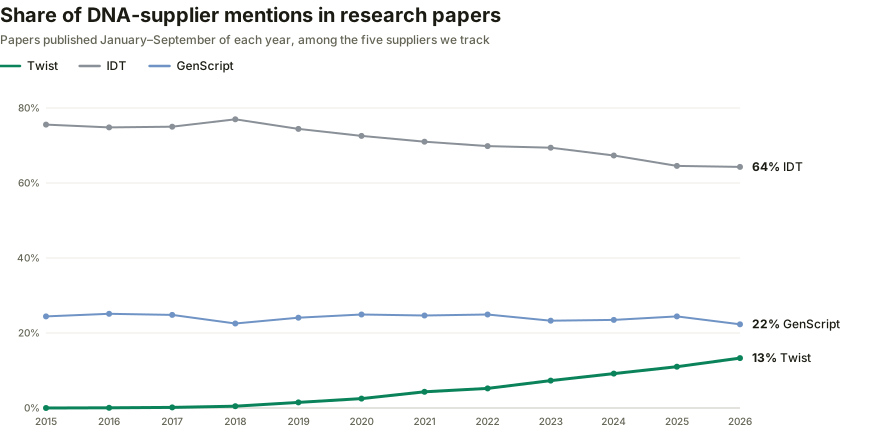
- Twist went from absent to one in eight mentions. Its share has risen every year since 2017 and grew fivefold after 2020.
- IDT is still the default, but less so. Its share slid from 74% in 2019 to 64%, while GenScript has held near a quarter.
- Twist is still growing fastest. Papers naming Twist rose 41% from January through September compared with the same months of 2025, against 16% for IDT and 7% for GenScript.
Recent months are still being indexed, which trims every supplier’s count, so shares are steadier than raw totals.
Each supplier owns a different kind of DNA
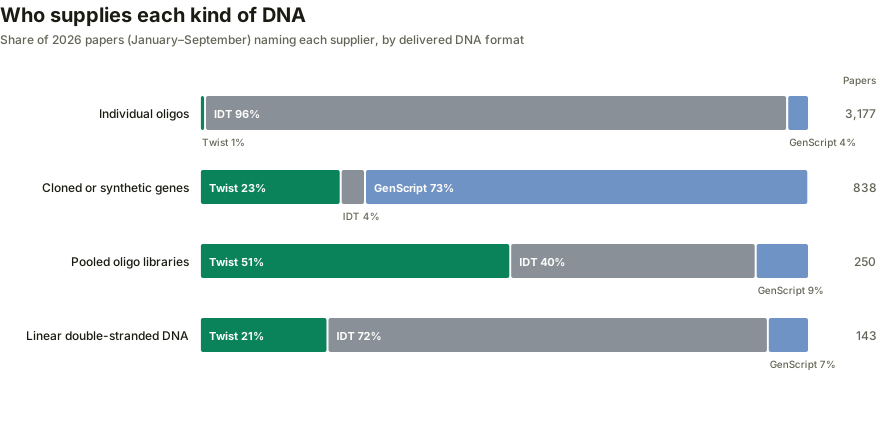
IDT is the default for individual oligos, the primers and probes nearly every lab orders, and Twist barely registers there. Twist’s gains come where it competes with GenScript: papers naming Twist for synthetic genes have grown nearly tenfold since 2020.
Pooled oligo libraries are where Twist leads
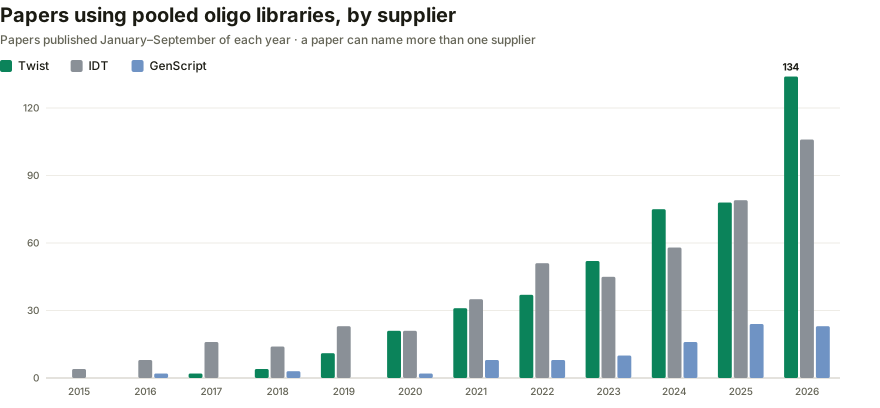
Pooled oligo libraries, thousands of designed sequences made together, power CRISPR screens, deep mutational scans and AI-guided protein design.
- They are the fastest-growing format. Papers using them grew about sixfold from 2019 to 2025, and their share of supplier-naming papers rose from 1.4% to 3.4%.
- Twist pulled ahead in 2023 and is ahead again this year. IDT drew level in 2025, but Twist is named in 51% of 2026 library papers.
Enzymatic synthesis hasn’t shown up yet
Two newer companies, Elegen and Ansa, make DNA with enzymes instead of chemistry, aiming for longer and more accurate sequences. Together they appear in about ten papers, all since 2024. Papers describe work done a year or more earlier, so it is too soon to read much into that.
How we built this
This study draws on a Village monitor that our agent built on PubMed Central’s open-access collection, searched through NCBI’s E-utilities. For each paper that names Twist, IDT, GenScript, Elegen or Ansa, an AI classifier reads the full text, keeps the paper only if it describes using that supplier’s DNA, saves the quoted passage and records the delivered format. A second pass re-reads the mentions the first left undecided, mostly primers and probes. Studies are deduplicated by DOI, preprints are left out so a study isn’t counted twice, and years are compared over January through September, with data through September 2026.