US companies are seeking fewer foreign software developers, and far more “AI engineers”
Before a US employer can sponsor a foreign worker for an H-1B, the main US work visa for skilled professionals such as software engineers, it must file a Labor Condition Application, or LCA, with the Department of Labor, attesting that it will pay at least the prevailing wage for the job. The department publishes each application it decides, including the job title the employer wrote, in its LCA disclosure data, about half a million certified H-1B filings a year. Together these filings form a public record of which roles companies want to fill with foreign workers and what companies call those roles. The federal fiscal year starts in October and the latest published data runs through June 2026, so we compare October through June of each fiscal year.
Software filings fell more than twice as fast as H-1B filings overall
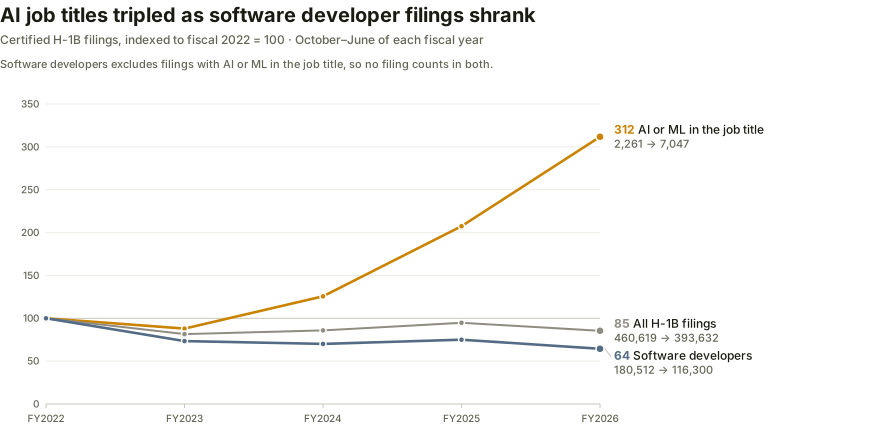
- Software filings fell 36% from fiscal 2022 to fiscal 2026, comparing October through June of each year.
- Filings for new hires fell even faster. Counting only filings for new employment rather than renewals or employer changes, software fell 46%.
- Filings with AI job titles are still rare. They made up 1.8% of all certified H-1B filings in fiscal 2026.
Software filings fell in two steps. They dropped 27% in fiscal 2023, a year of widespread tech layoffs, and recovered slightly by 2025. They fell another 14% in fiscal 2026, most steeply from October to December 2025, right after the White House announced a $100,000 fee on new H-1B petitions. That quarter was down 26% from a year earlier; by April to June, the gap had narrowed to 5%.
Some of the growth in AI job titles may be existing work under a new name. Titles that spell out “machine learning” or “artificial intelligence” rose 80%, while shorter titles such as “AI engineer” grew much faster and supplied 92% of the latest year’s increase.
More than three times as many employers now use AI job titles
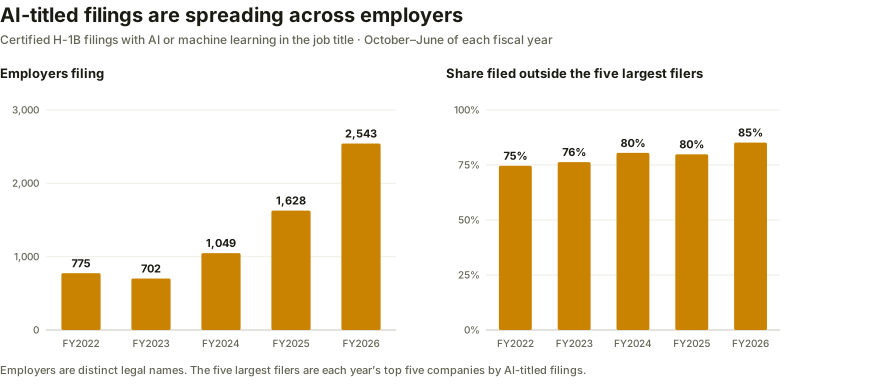
- Most employers filed just one. Two-thirds of fiscal 2026’s employers with AI job titles submitted a single filing.
- The biggest filers’ share is shrinking. Employers outside the five largest submitted 85% of AI-titled filings in fiscal 2026, up from 75%.
- Growth doesn’t depend on the biggest filers. Leaving out fiscal 2026’s five largest, among them Apple, LinkedIn and Meta, AI-titled filings still rose 250%.
OpenAI and Anthropic rarely put AI in their job titles. Of their 402 certified filings from October through June of fiscal 2026, only 11% included AI or machine learning in the title; most were for some version of “Member of Technical Staff.”
Software filings rose at some of the largest tech firms and fell sharply at others
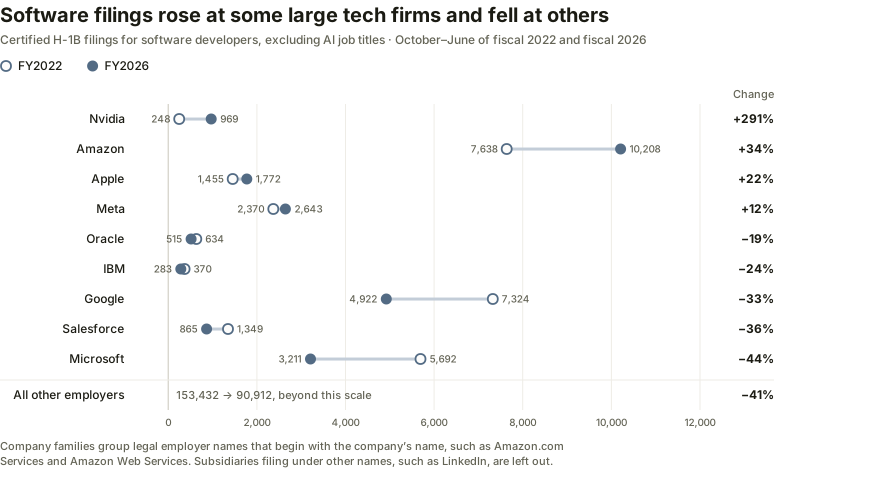
- Microsoft’s software filings fell 44% and Google’s 33%, two of the three steepest drops among the nine companies, along with Salesforce’s.
- Nvidia’s nearly quadrupled and Amazon’s rose 34%. Amazon’s share of all software filings rose to 8.8% from 4.2%.
- The decline is concentrated outside big tech. The nine companies combined filed 6% fewer for software developers; all other employers filed 41% fewer.
How we built this
We used the Department of Labor’s quarterly LCA disclosure files from fiscal 2022 through the third quarter of fiscal 2026, counting each certified H-1B filing once and dating it by its decision. Software developers are filings in the software-developer occupation codes, minus those with AI job titles so the two groups don’t overlap; including them, software still fell 34%. AI job titles contain “machine learning”, “artificial intelligence”, “AI” or “ML” as whole words. Employers are counted by legal name, and company families group the legal names that begin with each company’s name.
An LCA is an employer’s attestation filed before a visa petition. It isn’t an approved visa, a hire or a unique worker, and one filing can cover several positions or a renewal for someone already employed; counting requested positions instead of filings, software fell 25%. Employers write their own job titles, which can change without any change in the work, and these counts can’t show whether AI caused any of the shift.