The concentration behind observability’s web presence
Village’s study of 25.7 million web hosts reveals how three shared platforms can reverse Datadog’s apparent lead over New Relic.

The monitoring code on a website may tell investors more about its hosting platform than its owner’s software choices. Village’s captures of scripts, requests, and redirects let analysts follow those connections across millions of hosts, revealing concentrations that a vendor total can obscure. In this study, three shared platforms account for enough detections to reverse Datadog’s apparent lead over New Relic.
When software fails, observability tools help companies understand where and why. Measuring their adoption is harder because code found on a website may reflect a choice made by its owner, its website platform, or an embedded service.
In Village’s September crawl, for example, Datadog’s code appeared on about 35,000 more web hosts than New Relic’s. That lead was smaller than the 38,000 Datadog detections linked to just three platforms: Substack, Square.site, and JaneApp. Removing those hosts from every vendor’s count puts New Relic ahead.
Village builds its web capture dataset by loading pages in a browser and recording the scripts they load, the services they contact, and the redirects they follow. For this study, we searched those records for signals of ten observability vendors across 25.7 million hosts, then examined individual detections to see how shared software affected the comparison.
Sentry’s wide lead
Sentry appears on 1.5 million hosts, almost six times Datadog’s 263,000, with New Relic next at 228,000. That lead holds in every popularity band in Google’s Chrome User Experience Report (CrUX), which groups sites by visits from eligible Chrome users.
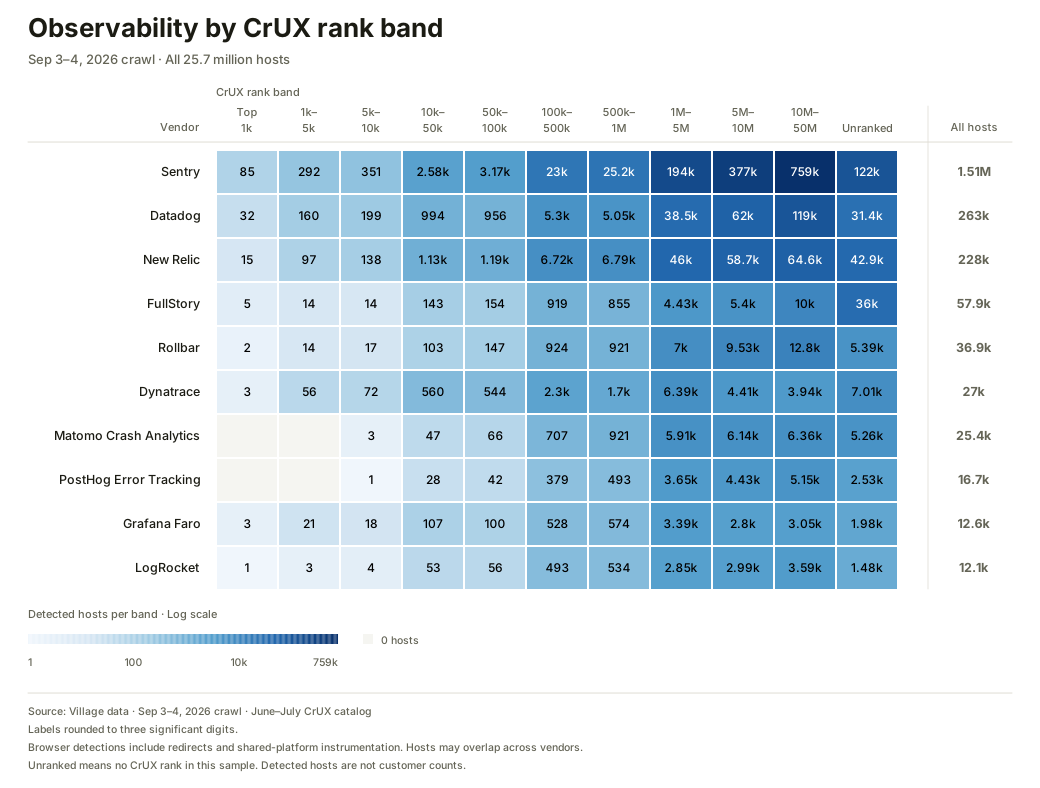
Figure 1. Detected hosts by CrUX rank band, before grouping or platform exclusions. Colors show counts on a logarithmic scale; because bands differ in size, darker cells need not indicate higher detection rates. A host can carry signals from more than one vendor. Source: Village data, September 3–4, 2026 crawl; June–July 2026 CrUX catalog.
Below Sentry, the order depends on site popularity: Datadog leads New Relic in the top-10,000 bands, but New Relic leads from 10,000 through 5 million. Dynatrace also fares better among popular sites, moving from sixth overall to fourth in the top-100,000 bands.
One service, thousands of sites
These totals also depend on how repeated appearances are counted. Following redirects and grouping hostnames by destination domain cuts Datadog’s count from 263,000 hosts to 126,000 domains, and Sentry’s from 1.5 million to 1.04 million. We then grouped domains that shared complete, verified monitoring configurations.
Among Sentry’s roughly 819,000 domains left unmerged, about 493,000 link to Wix and 93,000 to Squarespace, mainly through hosting or shared code. Those links do not prove shared monitoring accounts, but they expose a concentration that the original host total conceals.
Figure 2 breaks down the domains left unmerged for each vendor, including those without enough configuration evidence to match. Each bar uses that vendor’s remaining domains as its denominator.
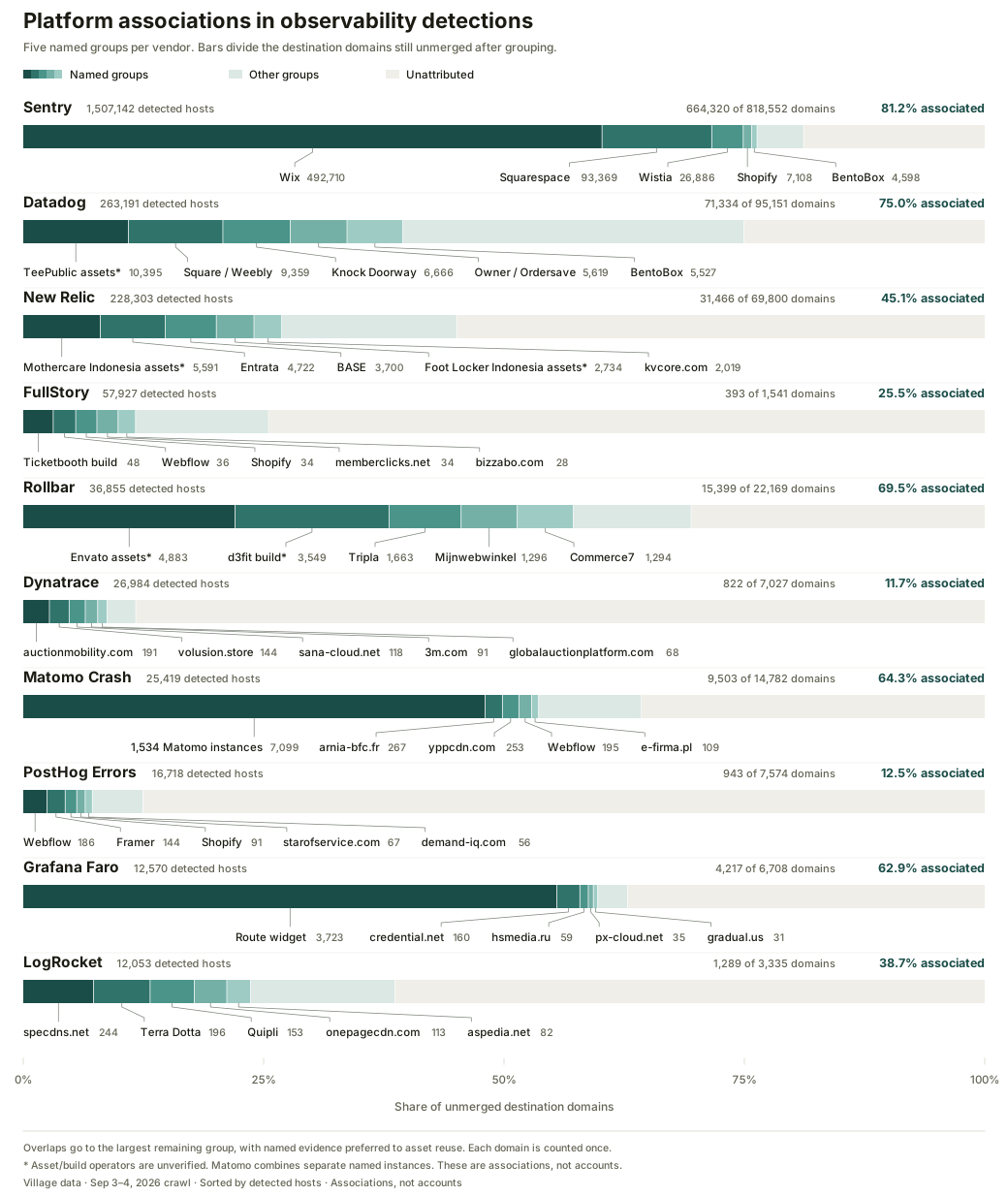
Figure 2. Shared-platform associations among unmerged destination domains. Each domain counts once within a vendor’s bar, and labels identify the five largest groups. The denominator is that vendor’s unmerged domains, not the original host total above the bar. Associations include traced requests, shared hosting, code, or assets. Source: Village data, September 3–4, 2026 crawl.
Village’s captured request chains help explain how these concentrations arise: Wistia’s video software, for example, loaded Sentry on nearly 27,000 domains. A similar connection appears in the Grafana Faro group, where 3,712 of the 3,723 domains linked to Route’s Shopify widget carried Faro code alongside monitoring data naming Route’s application. The software source is clearer than the commercial relationship: identifying Route’s application does not establish a Grafana Cloud contract.
Shared services also affect which vendors appear together: Substack, Square.site, and JaneApp account for about 40% of the 95,839 hosts carrying both Sentry and Datadog across the full crawl. Removing those original hosts from every vendor’s count cuts the share of Datadog hosts also showing Sentry from 36.4% to 25.6%.
Among the original hosts in the top-100,000 CrUX bands, Sentry is also more common than New Relic alongside Datadog. Before platform exclusions, 336 of the 2,341 Datadog hosts show Sentry (14.4%), compared with 56 showing New Relic (2.4%).
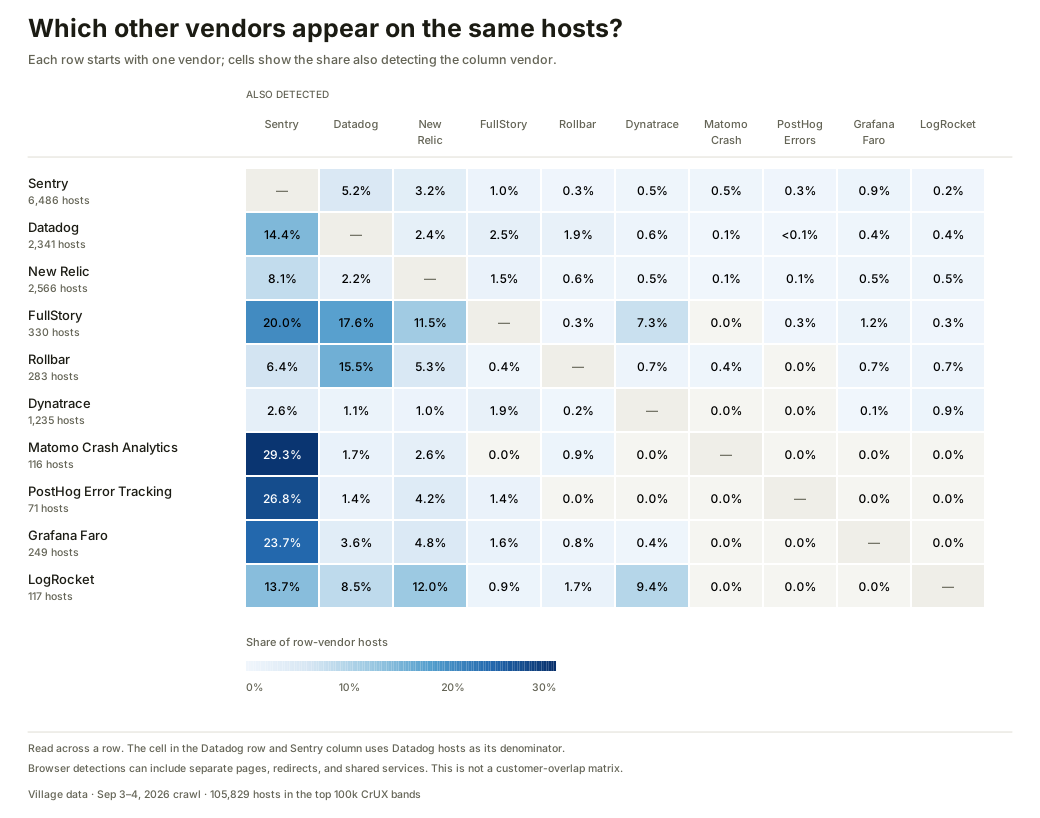
Figure 3. Vendor overlap within the top-100,000 CrUX bands: 105,829 hosts, a separate population from the full-crawl comparison above. Each cell shows the share of the row vendor’s hosts also carrying the column vendor’s signals. Source: Village data, September 3–4, 2026 crawl.
Sentry remains more common than New Relic alongside Datadog under all six counting and filtering checks. Establishing who chose those tools is harder, since two vendors on one host may reflect either one company’s choices or monitoring brought in by separate services.
What the browser misses
While shared platforms can put a monitoring vendor’s code on thousands of websites, companies can also use a vendor without leaving evidence on their public pages. To investigate that less visible use, we compared Village’s browser captures with public disclosures for the Forbes AI 50.
Public disclosures more than doubled Datadog’s count in the 2026 cohort, adding eight companies to the seven identified through browser evidence. We counted each company once per vendor and required browser signals to be traceable to company software, excluding evidence from hosted services alone. Because the AI 50 is a selected group of prominent private companies, these results cannot stand for the whole AI startup market.
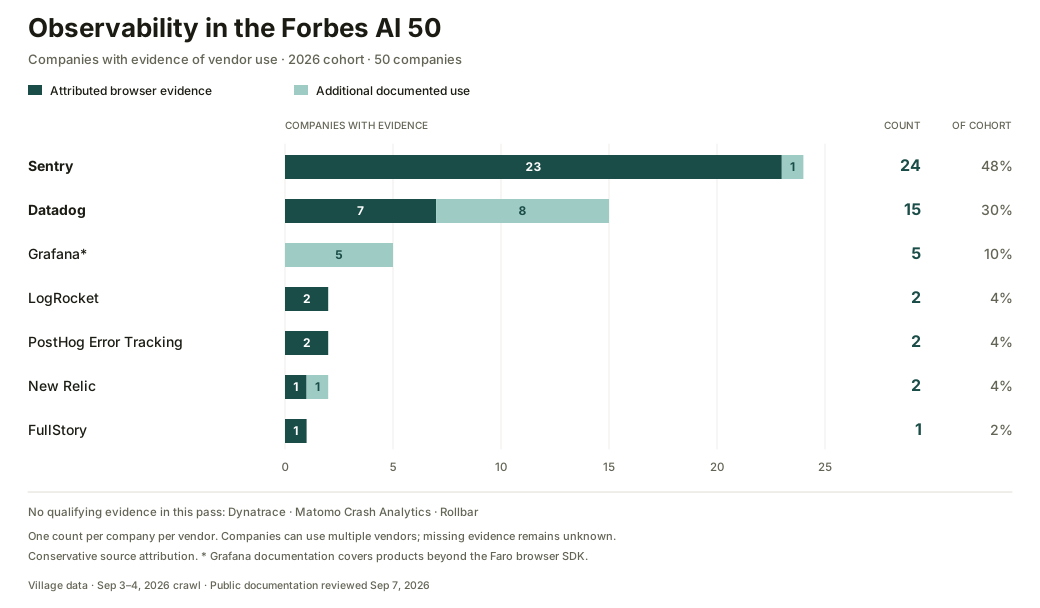
Figure 4. Companies with evidence of vendor use among the Forbes AI 50. Dark bars count companies with attributed browser evidence; light bars add those supported only by public documents. Grafana disclosures cover products beyond the Faro browser library measured above. Source: Village data, September 3–4 crawl; documents reviewed September 7, 2026. Missing evidence remains unknown.
Together, the two sources identify Sentry at 24 companies, Datadog at 15, and Grafana at five, with all five Grafana relationships coming from documents. The disclosures can also explain the jobs each tool performs: Gamma lists Datadog for application logging, alerting, and telemetry, and Sentry for error logging. Grafana’s Lovable case study describes metrics, logs, traces, and profiles in Grafana Cloud, a broader relationship than the Faro browser library measured in the web survey.
Village’s web capture data gives investors a way to test an apparent lead by inspecting individual detections, identifying shared platforms, and comparing the totals after their removal. Company disclosures extend that investigation to uses the browser cannot see, helping explain the software relationships behind the numbers.
Method and limits
Village data covers 25,725,429 hosts captured on September 3–4, 2026, labeled the week of August 31. That total comprises 20,728,232 hosts in the June–July CrUX catalog and 4,997,197 unranked additions; combining CrUX publications produces 105,829 hosts in the top-100,000 bands. CrUX measures popularity, not company size or spending; its coverage is described in Google’s methodology.
The three browser figures use the same ten vendors and detection rules. For all vendors, including PostHog Error Tracking and Matomo Crash Analytics, detected code and requests do not always prove that collection is enabled or data are processed. Capture success and the pages visited vary by band, but restricting the analysis to one successfully loaded homepage per host preserves the leading three vendors and their order in every band.
The three-platform check excludes the same original hosts from every vendor when any retained detection’s destination falls under substack.com, square.site, or janeapp.com. Custom domains qualify only if they redirect into those roots. This removes 38,413 Datadog detections, exceeding its 34,888-host lead over New Relic, and the reversal also holds for successfully loaded homepages. The result compares host detections; it is neither a customer estimate nor a ranking by domains.
Across the six top-100,000 checks, 11.0–15.6% of retained hosts or domains with Datadog signals also show Sentry, compared with 2.4–3.5% for New Relic. Because these signals may come from different pages or services, their overlap does not establish a shared buying decision.
We reproduced evidence for 1,000 sampled vendor-host matches and checked ten domains from each of 50 platform groups. Further checks found 634 additional matches across the vendors, with each vendor’s own additions amounting to less than 0.2% of its count. These additions remain outside the figures to keep the rules consistent; the checks do not estimate overall rates of false detections or missed installations.
The AI 50 review covered 500 company-vendor combinations and excluded three relationships supported only by a root-page script list. As in the web survey, PostHog analytics alone does not qualify as Error Tracking. The documents reflect evidence available on September 7, which may differ from what was available on the crawl dates. Adding document-only relationships to browser matches gives Sentry 23 + 1 = 24, Datadog 7 + 8 = 15, and Grafana 0 + 5 = 5.