For the first time this century, Taiwan exports more to the US than to China and Hong Kong, as shipments of AI hardware surge
Every month, Taiwan’s Ministry of Finance reports how much the island exports, where the goods are going and what they are. Taiwan’s factories supply many of the chips and servers behind the AI build-out, so these tables show where that hardware ships first. Taiwan’s export destinations have shifted quickly. Hong Kong, a common stopover for goods bound for mainland China, is reported separately, so this study compares the US with China and Hong Kong combined and with mainland China alone.
For the first time this century, Taiwan ships more to the US than to China and Hong Kong combined
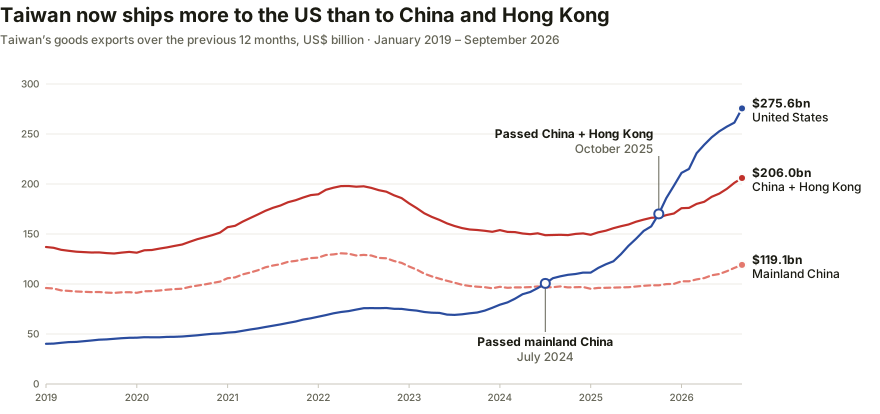
- The lead has held for a full year. Taiwan has shipped more to the US than to China and Hong Kong combined in each of the 12 months since October 2025.
- Mainland China alone fell behind earlier. The US passed it on a 12-month basis in July 2024, its first lead over the mainland since early 2004.
- Exports to China and Hong Kong are still growing. They rose 28.5% in the first nine months of 2026 from a year earlier, though US-bound exports grew faster.
The ministry’s monthly records begin in January 2001, when the US narrowly led. It didn’t lead again in any month until February 2025, and then by just $56 million; the lead reversed twice before the current run began. Measured over 12 months, the US had never led China and Hong Kong before October 2025.
Computers account for all of the lead
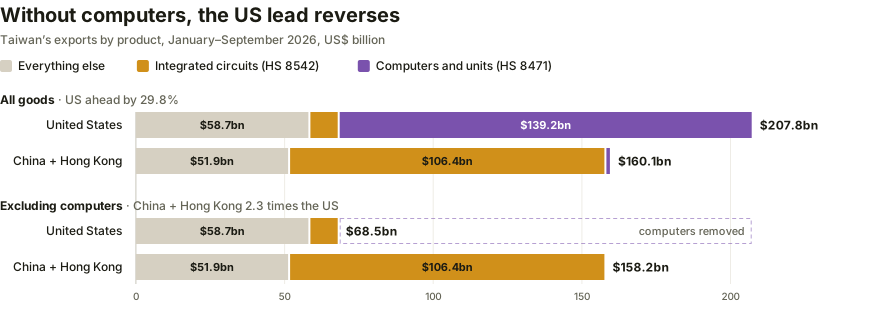
- Computers are two-thirds of what Taiwan ships to the US. The customs category for computers and their units (HS 8471), which includes servers and graphics cards, made up 67.0% of US-bound exports from January through September.
- Without them, China and Hong Kong lead by more than two to one. Mainland China alone also leads, and China and Hong Kong have come out ahead on this basis in every month since January 2023, the start of our monthly product data.
- Chips mostly go to China and Hong Kong instead. China and Hong Kong received about 11 times as much in integrated circuits (HS 8542) as the US.
Computers also drove the growth, supplying 83.9% of the rise in Taiwan’s US-bound exports from 2024 to 2025. Tariff uncertainty may have pulled some shipments forward, as Taiwan’s National Development Council has said. But US-bound computer exports had already risen 140% in 2024, before the reciprocal tariffs were announced, and US customs guidance in April 2025 excluded computers and chips from the reciprocal tariffs. Tariff timing doesn’t explain the jump in computer exports.
Mexico went from 0.5% to 8% of Taiwan’s computer exports in three years
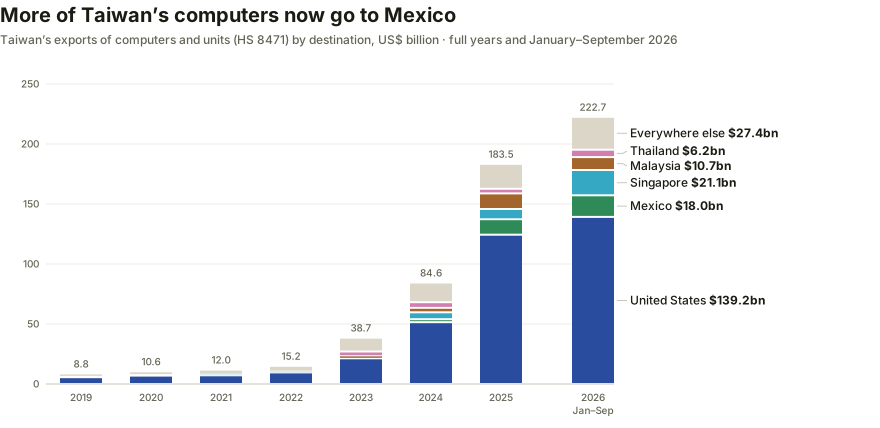
- Taiwan’s exports to Mexico more than quadrupled from 2023 to 2025. Computers now make up most of them.
- Mexico sends nearly all of its own computer exports to the US. It reported shipping 92.5% of them there in 2025, according to UN Comtrade.
- The Southeast Asian hubs are mixed. Taiwan’s computer shipments to Malaysia fell 6.7% in the first nine months of 2026, while those to Singapore and Thailand rose.
Customs data can’t trace a shipment from Taiwan through Mexico to the US, and some of these computers serve Mexican or other non-US buyers. But the numbers are consistent with Taiwanese manufacturers finishing servers in Mexico and selling them to US customers. Wiwynn, a Taiwanese server maker, began mass production at a rack-assembly plant in Mexico in the first half of 2024, and Mexico sends 92.5% of its own computer exports to the US. If even part of Taiwan’s $18.0bn in computer shipments to Mexico ends up in the US, the US share of Taiwan’s computer exports is above the 62.5% that direct shipments show.
How we built this
Destination totals come from the Ministry of Finance’s monthly exports by country, January 2001 to September 2026; 12-month totals sum the latest revised months. Product detail comes from the ministry’s monthly Table 8, exports by selected commodity and country, using the December editions for 2018 through 2022 and every edition since January 2023. Annual and January–September product values use the cumulative totals each edition publishes rather than sums of first-release months, because the ministry revises categories between editions; the latest edition’s destination totals match the country series exactly. Mexico’s exports come from its own reports to UN Comtrade. All values are gross exports in current US dollars.
These values include imported components and price changes, so they don’t measure Taiwan’s value added or how many machines shipped. HS 8471 also covers PCs and peripherals, so it isn’t a measure of AI servers alone, although the ministry ties its growth (in Chinese) to servers, graphics cards and data-center construction. HS 8542 includes chip parts. Destinations are where goods were declared to go, and Hong Kong, Mexico and the Southeast Asian hubs can be intermediate stops. Removing a product category shows what the lead is made of; it can’t say what trade would look like without the AI build-out.