Frontier AI used to take over a year to get 10 times cheaper. Now it takes months.
AI prices are usually quoted per token, but what a business pays for is a finished task at a given level of quality. Village’s LLM Atlas estimates both: a capability score for each model and reasoning setting, and what each one costs to complete a typical agentic task, such as fixing code in a terminal or drafting a professional document. That lets us track, over time, what each budget buys and the cheapest way to match a landmark model. The price of each landmark has collapsed, and the newest ones are falling fastest.
The same money buys far better AI every year
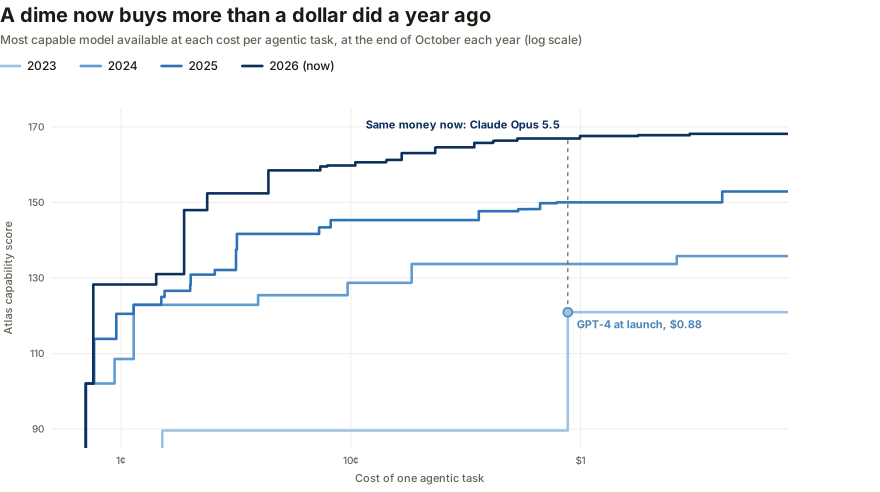
- GPT-4’s launch price now buys Claude Opus 5.5. GPT-4 cost 88 cents a task in 2023; Opus 5.5, among the most capable models in Atlas, costs less than that at high effort.
- The shift happens every year. In each of the past two years, the best model for a dime outscored the best model for a dollar a year earlier.
Every landmark model is now cheap to match
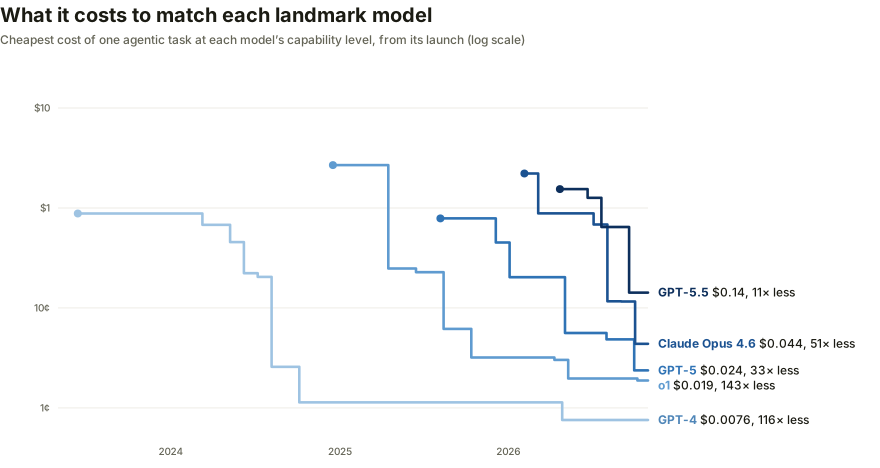
- GPT-5-level work costs a thirty-third of what it did at launch. An agentic task that cost 79 cents with GPT-5 in August 2025 costs about 2 cents with OpenAI’s GPT-6 Luna.
- o1-level work is 143 times cheaper. OpenAI’s first reasoning model cost $2.68 a task in December 2024; the same level now costs under 2 cents.
- Even this year’s frontier is already a bargain. Matching Claude Opus 4.6, released in February, is 51 times cheaper today.
Much of the drop comes from cheaper tiers that need less reasoning to reach the same quality: today’s cheapest way to match o1 is GPT-6 Luna with reasoning switched off. Short questions have fallen even further than agentic tasks, with GPT-5-level questions 171 times cheaper than at launch.
Newer levels get cheap faster
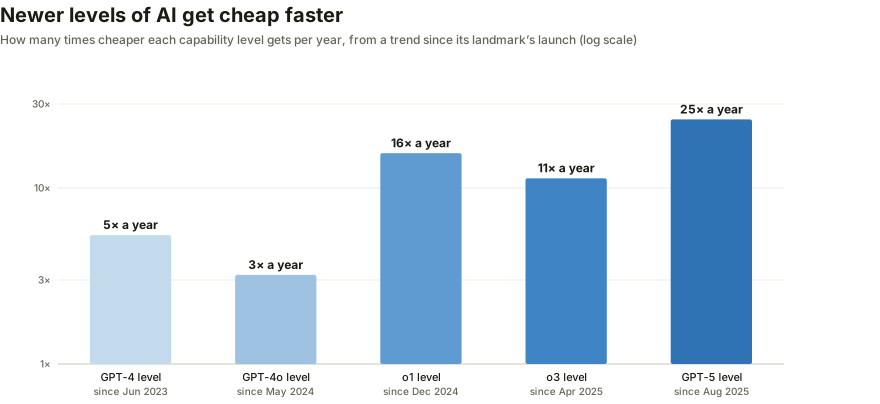
- The levels set by GPT-4 and GPT-4o have fallen 3 to 5 times a year.
- The levels set since o1, at the end of 2024, are falling 11 to 25 times a year.
The gap between the frontier and the cheap tier is closing faster too. GPT-4-level work took 14 months to get 10 times cheaper; the levels set since late 2024 got there in 4 to 9 months.
How we built this
This study uses Village’s LLM Atlas, which estimates a capability score for each model and reasoning setting from public benchmark results and, with a separate cost model, the typical dollar cost of a task from evaluators’ runs, described in its methodology. Agentic tasks are the cost model’s Terminal-Bench 2.1 and GDPval workload. The frontier on a given date is the most capable setting at each cost among models released by then. A level is a landmark model’s capability score; on each date, its cost is the cheapest setting of any model released by then that scores at least that high. Yearly rates are straight-line trends in log cost since each landmark’s launch, for levels with at least a year of history. The scores and costs are from October 31, 2026; Atlas updates as new results arrive.
Each model has a single cost estimate at the prices evaluators paid, so it does not track later price cuts to older models. Counting a model only when the low end of its score’s uncertainty range clears the level, or using only models scored on at least 10 benchmark families, gives the same picture, though the yearly rates for individual levels move by up to a few times.